When you're weighing spirit island vs gloomhaven for couples who share one game shelf, the answer in 2026 comes down to three things: how much linear shelf real estate you can spare, how many evenings per month you actually play, and whether you want a campaign that ends or a sandbox that scales forever. Gloomhaven (and its bigger sibling Frosthaven) demands a shelf of its own. Spirit Island lives in one tall box that grows sideways through expansions. For most two-person households the verdict is closer than online debates suggest, and the right pick depends on your storage, not your taste.
The shelf footprint nobody talks about
Open any board game subreddit and you'll see endless debate about complexity, theme, and replay value. Almost nobody mentions the boring number that matters most for couples in apartments: how many centimeters of shelf the box actually consumes.
The original Gloomhaven retail box measures roughly 30 x 30 x 18 cm and weighs nearly 10 kg. Frosthaven is even larger and heavier. Jaws of the Lion, the shelf-friendly entry point, fits in a box closer to the size of a paperback novel stack. Spirit Island's base box is tall and narrow (around 30 x 30 x 7.5 cm) and weighs about 2 kg. With four expansions out the door, a fully-loaded Spirit Island collection still fits in a single cube of an IKEA Kallax. A fully-loaded Gloomhaven plus Forgotten Circles plus Jaws of the Lion plus Frosthaven? You're looking at the entire bottom row of that Kallax.
If you and your partner own roughly 30 games and have one shared shelf, that math matters more than complexity ratings. Read more about organizing a small-apartment board game shelf if storage is your real blocker.
Play cadence: how often do you actually sit down?
Gloomhaven is a campaign. It rewards consistency. Couples who play 1-2 times per week, with the same two characters, will finish (or at least meaningfully progress) the 90-150 scenario story arc. Couples who play sporadically - say, twice a month with a three-week gap - will lose the thread, forget which envelope they opened, and the campaign will stall. Stalled Gloomhaven campaigns become couch-table guilt.
Spirit Island has no campaign. Every session is self-contained. You pick spirits, you pick an adversary level, you play 90-120 minutes, you put it away. There's no envelope to misplace, no character sheet to lose, no story thread to forget. The downside is no narrative payoff. The upside is that a Spirit Island session four months after the previous one is no harder than the previous one was.
If you and your partner play board games consistently (weekly, ideally), Gloomhaven gives you a richer experience. If your schedules are unpredictable - travel, kids, shift work - Spirit Island wins by default.
Complexity curve and learning together
Spirit Island has the harder first game. You sit down, you flip the rulebook, and you confront a system with simultaneous play, growth phases, power cards, fear tracks, ravage and build phases, blight, dahan, and four to eight spirits each with unique mechanics. The first playthrough is brutal for many couples. The second is significantly smoother. By the fifth session the rules are reflex and you're optimizing across spirit synergies.
Gloomhaven drips its rules out slowly via envelopes and unlocks. The first scenario uses maybe 30% of the eventual rules. By scenario 20 you've absorbed enemy AI decks, looting, status effects, retirement mechanics, the city event system, the road event system, the shop, and the achievement tree. Couples who like learning a game together by chunking it over months prefer this. Couples who'd rather just absorb the whole system in one painful session and then play crisply will prefer Spirit Island.
Two players, true two-player design
Both games support two players, but the experiences are not equivalent. Gloomhaven plays slightly better at three than at two - you get more class synergies and the difficulty math balances more cleanly. Spirit Island plays equivalently well at any count, and many couples report it as their favorite two-player co-op specifically because each player has full ownership of a spirit and there's no down-time bottleneck.
For a deeper look at the broader two-player co-op category, see our 2026 guide to the best two-player cooperative board games.
Spirit Island vs Gloomhaven: at-a-glance comparison
| Factor | Spirit Island | Gloomhaven |
|---|---|---|
| Box size | ~30 x 30 x 7.5 cm | ~30 x 30 x 18 cm |
| Weight | ~2 kg | ~10 kg |
| Setup time | 10-15 min | 20-30 min |
| Session length (2P) | 90-120 min | 60-120 min per scenario |
| Campaign structure | None - sandbox | ~95 scenario branching campaign |
| Lost-progress risk | None | High if play gaps exceed 3 weeks |
| Two-player balance | Excellent | Good (slightly better at 3) |
| Learning curve | Steep first game, smooth after | Gradual via envelope unlocks |
| Replay after "completion" | Infinite via spirits + adversaries | Limited - characters retire |
| Best for | Sporadic players, small shelves | Weekly players, dedicated space |
The verdict by couple type
The honest spirit island vs gloomhaven for couples who share one game shelf verdict breaks down by play frequency, not by taste. If you and your partner share one shelf and play 1-2 times per month, Spirit Island is the unambiguous pick. Its small footprint, lack of campaign commitment, and infinite scaling make it the lower-friction choice. You can come back to it after a six-month gap without losing anything.
If you share one shelf but are aggressive players (weekly or more), Gloomhaven Jaws of the Lion is the shelf-friendly entry to the Gloomhaven world. It's a 25-scenario campaign in a paperback-sized box. Finish that, decide if you want to upgrade to full Gloomhaven or Frosthaven, and you've made an informed shelf-space decision rather than committing 18 cm of vertical shelf to a box you might not love. See our Jaws of the Lion vs Frosthaven buyer's guide for that next step.
If you have unlimited shelf space and play weekly with discipline, get Frosthaven. It's the most game per dollar in the category.
If you want both - the heavy co-op AND the campaign experience - get Spirit Island first, master it over a year, then add Jaws of the Lion. Together they cover roughly 8 cm of shelf width.
Shelf companions worth pairing with either pick
Couples who buy a heavy co-op like Spirit Island or Gloomhaven almost always also need 1-3 fast, low-setup games for nights when the bigger box feels like work. Below are three space-efficient picks that earn their place on a shared couples' shelf without crowding out the headliner.
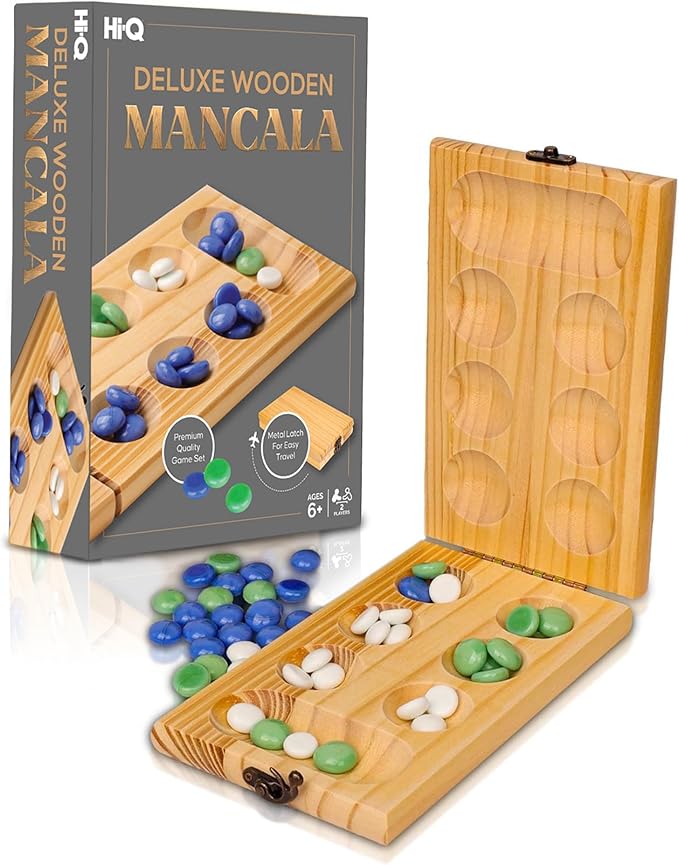
Hi-Q Solid Wood Deluxe Mancala Folding Board Game
Mancala is the perfect "I'm tired but want to play something with my partner" game. It folds in half, stores flat on top of taller boxes, takes 30 seconds to set up, and runs 10-20 minutes per round. The Hi-Q solid wood edition has weighted gemstones and a satisfying snap-shut latch - meaningfully better tactile feel than the plastic versions you'll see in big-box stores. For couples who want a quick, no-rules-reading game to fill the gap between heavy co-op nights, this is the obvious shelf companion. Available at Amazon.
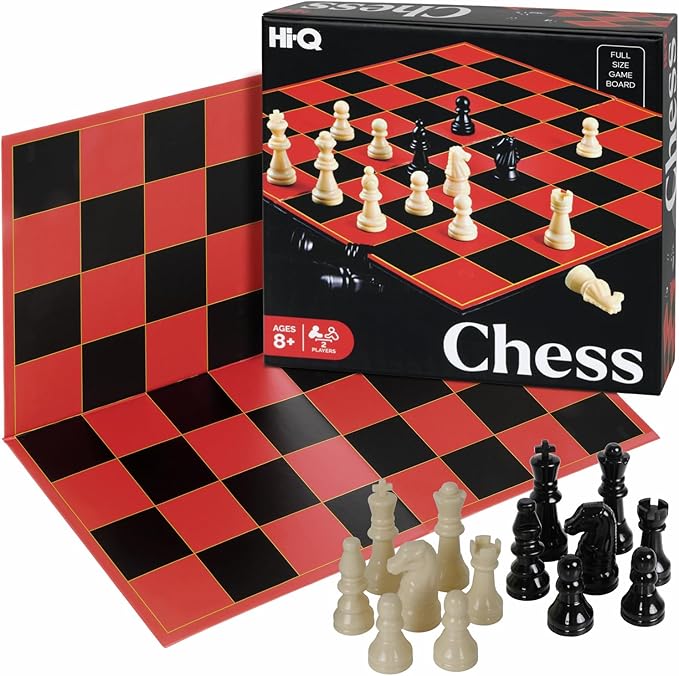
Hi-Q Classic Chess Board Game
If one of you wants to keep growing as a player and the other is curious but intimidated, a real wooden chess set on the shared shelf is a quiet invitation. The Hi-Q classic set is a folding wooden board with felted pieces - mid-tier quality, durable, and presentable enough to leave mid-game on a coffee table without it looking like clutter. Pair it with a chess app for puzzles between matches. Listed at Amazon.
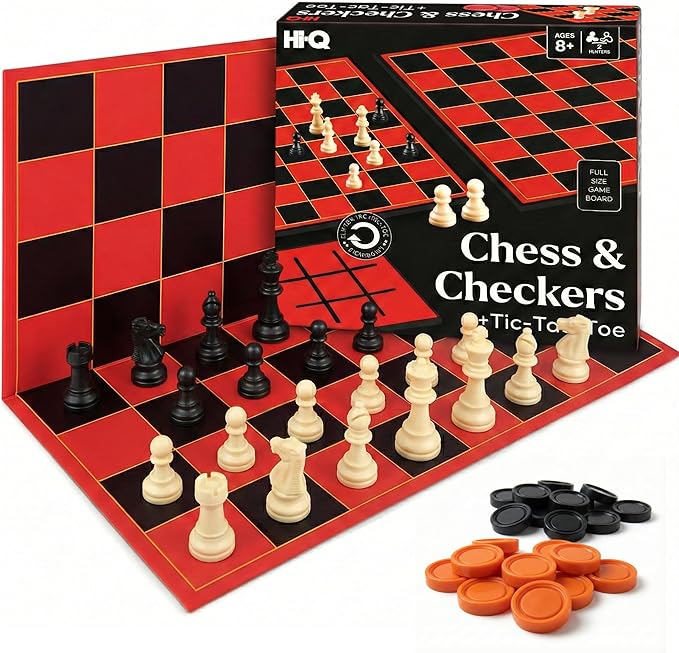
Hi-Q 3-in-1 Chess, Checkers & Tic-Tac-Toe Folding Set
If shelf space is the constraint, the 3-in-1 set is the highest ratio of games-to-shelf-cm you can buy. One folding wooden case, three classic two-player games. Less premium than a dedicated chess set, but if you're already committing the lion's share of your shelf to Spirit Island and Gloomhaven, this is the smart way to add three filler games in the same vertical space as a single deck of cards. Available at Amazon.
The campaign-completion problem, honestly
The single most common Gloomhaven failure mode for couples is the half-finished campaign. Two years in, scenario 47, one partner loses interest, and the box sits on the shelf forever. Spirit Island has no equivalent failure mode - there's nothing to finish, so there's nothing to abandon.
If you're the kind of couple that has unfinished TV series, half-read books, and a Peloton in the garage, take this honestly. Gloomhaven is a commitment. Don't buy it for the shelf aesthetic.
If you finish things you start, Gloomhaven's payoff at the end of a campaign is genuinely cinematic - you watch your characters' arc complete, you trigger retirement events, you unlock the late-game classes. There's nothing else quite like it in the hobby.
Buying in 2026: what changed
Spirit Island's Nature Incarnate expansion (released 2022) is now considered the best entry point for new spirit variety. The base game plus Nature Incarnate, plus the smaller Branch & Claw expansion, is the modern "complete" Spirit Island shelf. Jagged Earth is the deepest expansion but is recommended only after at least 20-30 base-game plays.
Frosthaven's reprints in 2025-2026 cleaned up the early-print rule errata. If you're buying Frosthaven new in 2026, you're getting the corrected edition. Used copies from 2023 may have the old rulebook - check before buying.
For Spirit Island expansion order, see our expansion buying guide.
Frequently Asked Questions
Is Spirit Island or Gloomhaven better for a couple who only plays once a month?
Spirit Island, unambiguously. Gloomhaven's campaign structure punishes irregular play - you forget rules, lose track of which character abilities you'd selected, and the narrative thread breaks. Spirit Island sessions are self-contained, so a one-month gap costs you nothing. This is the single biggest factor in the spirit island vs gloomhaven for couples who share one game shelf decision.
Can two players play Gloomhaven with just two characters or do you need to run extra ones?
Two players with two characters is the standard configuration and works fine. Some couples run a third "ghost" character for difficulty balance, but it's not necessary. The game scales scenario difficulty to player count, so two characters fight an appropriately scaled enemy count.
Does Spirit Island work as a two-player game without expansions?
Yes. The base game ships with four spirits, all of which work at two players. Branch & Claw and Jagged Earth add more spirits and complications, but the base box is a complete two-player game out of the box.
Which has more replay value after the first 10 games?
Spirit Island. The combinatorics of spirits, adversaries, scenarios, and difficulty levels mean session 50 still feels meaningfully different from session 5. Gloomhaven's replay value is high during the campaign but drops sharply after completion - retired characters don't come back, and Forgotten Circles plus the digital edition are the main ways to extend.
Is Jaws of the Lion a fair substitute for full Gloomhaven for couples?
For most couples sharing one shelf, yes. Jaws of the Lion is roughly a 25-scenario campaign with four characters, polished rules, and a much smaller footprint. It's the better starting point unless you're confident you'll play weekly for a year-plus, in which case go straight to Frosthaven.
Can you play Spirit Island and Gloomhaven solo if one partner is traveling?
Both support solo play. Spirit Island is widely considered one of the best solo board games in the hobby - one player controlling two spirits is the default solo configuration and works smoothly. Gloomhaven solo means running two characters yourself, which is slower but mechanically supported.
What's the resale value of each if we don't end up loving it?
Both hold value well on the used market. A complete, unpunched copy of Gloomhaven typically resells for 60-75% of retail. Spirit Island holds value similarly, with expansion-bundled lots commanding a small premium. Of the two, Spirit Island sells faster because more buyers can fit it on their shelf - which loops back to why the spirit island vs gloomhaven for couples who share one game shelf question is fundamentally a footprint question, not a taste one.
Key Takeaways
- Choosing the right spirit island vs gloomhaven for couples who share one game shelf means matching capacity and output ports to your actual devices
- Always check actual watt-hours (Wh), not just watts — runtime depends on Wh, not peak output
- Also covers: spirit island or gloomhaven for two players
- Also covers: best heavy coop game for couples
- Also covers: spirit island vs gloomhaven storage footprint
- Compare price-per-Wh across models to find the best value for your budget