If you are weighing scythe vs terraforming mars for first heavy strategy game purchase in 2026, the short answer is this: pick Scythe if you want a beautifully produced, asymmetric experience that teaches in 20 minutes and reliably finishes in 90, and pick Terraforming Mars if you want the deepest possible engine-building puzzle and you do not mind a slightly fiddly first session. Both are legitimate “gateway-to-heavy” titles, both have aged extremely well, and both reward repeat plays — but they solve very different problems for a first-time buyer stepping up from Catan, Wingspan, or Ticket to Ride.
This guide walks through the actual decision instead of just listing features. We will cover learning curve, playtime honesty, solo play, expansions, table presence, group dynamics, and the long-tail question almost nobody answers up front: which one will still be on your shelf in three years?
The 30-Second Verdict
Both games are “heavy” on BoardGameGeek’s weight scale (Scythe sits around 3.4/5, Terraforming Mars around 3.2/5), but the weight feels different at the table. Scythe’s complexity is upfront — once you understand your faction’s asymmetric power and the action wheel, the game flows. Terraforming Mars’ complexity is emergent — the base rules are simple, but the card interactions explode into a combinatorial puzzle that takes 3-4 plays to read fluently.
For a household buying their first heavy strategy game, that distinction matters more than rating averages. If you are the only enthusiast in a group of casual players, Scythe will get to the table. If you have a partner or roommate who genuinely loves spreadsheets, optimization puzzles, and tableau-builders like Ark Nova or Wingspan, Terraforming Mars will earn its space.
Scythe: The Asymmetric Engine
Designed by Jamey Stegmaier and released by Stonemaier Games in 2016, Scythe drops you into an alternate 1920s Eastern Europe where five (later seven, with expansions) factions compete for territory, resources, and prestige. You are not at war — combat is rare and almost always a calculated economic decision rather than a brawl.
What makes Scythe land as a first heavy game:
- Action wheel teaches itself. Every turn you pick one of four columns: each has a top (free) action and a bottom (paid, builds your engine) action. You cannot repeat the same column twice in a row. That single constraint generates the entire decision space.
- End trigger is transparent. The first player to place six stars (achievements) on the board ends the game. You always know how close the table is to the finish line.
- Production quality is class-leading. Realistic resource tokens, oversized mechs, Jakub Róžalski’s painted artwork. It is a game people ask to play because of how it looks.
- Playtime honest. 90-115 minutes once everyone knows the rules. Two-player games finish in 60.
Where Scythe frustrates: asymmetric faction balance is real but uneven, and a brand-new player handed Crimea or Rusviet can stumble while a veteran on Nordic or Polania runs away with it. Stonemaier publishes a recommended faction-mat pairing chart — use it for game one.
Terraforming Mars: The Engine Builder’s Engine Builder
Jacob Fryxélius’ 2016 design from Stronghold Games / FryxGames asks you to play a corporation hired to make Mars habitable. You raise the planet’s temperature, oxygen, and ocean count by playing project cards; when all three parameters hit their max, the game ends and the player with the most victory points wins.
What makes Terraforming Mars land as a first heavy game:
- Theme does heavy lifting. Playing “Asteroid” to raise the temperature and then “Lichen” to push oxygen feels narratively coherent in a way most euros do not.
- Decision depth scales with experience. Game one is “play cards I can afford.” Game ten is “sequence a 14-card engine that pays for itself by generation 5.”
- Solo mode is excellent. Beat the planet in 14 generations. The solo puzzle alone justifies the box.
- Massive card pool. The base game ships ~230 project cards. You will not see all of them in your first ten plays.
Where Terraforming Mars frustrates: the base box components are notoriously thin. The player boards are flat cardboard with cubes that slide if anyone sneezes. The “big box” from 2024 and the various player-mat upgrades from Stonemaier-style accessory sellers are basically required purchases for serious play. Budget another $40-80 on top of the MSRP.
Head-to-Head Comparison
| Factor | Scythe | Terraforming Mars |
|---|---|---|
| Teach time | 20-30 minutes | 30-45 minutes |
| First game length | 2 hours | 2.5-3 hours |
| Settled playtime | 90 minutes | 2 hours |
| Player count sweet spot | 2-4 | 2-3 |
| Solo mode | Automa (good) | Native solo (excellent) |
| Component quality | Premium out of box | Thin, upgrades recommended |
| Replay variance | Faction + mat combos | Card draw + corporation |
| Conflict level | Low-medium | Very low (multiplayer solitaire) |
| Table presence | Showpiece | Utilitarian |
| BGG weight | 3.43 | 3.24 |
| 2026 MSRP (base) | ~$80 | ~$70 (big box ~$120) |
The Question Behind the Question
Most people asking about scythe vs terraforming mars for first heavy strategy game purchase are really asking one of three things:
“Which one will my non-gamer partner actually play?” Scythe. Every time. The art, the minis, the shorter playtime, and the lower math overhead make it the easier sell. Terraforming Mars looks like homework to a non-gamer until they have played it twice.
“Which one will I still play in three years?” Terraforming Mars, slightly. The card variance means every game presents a different puzzle. Scythe’s asymmetric factions mask a fairly fixed strategic core — once you have played each faction twice, you have seen the game.
“Which one is better for two players specifically?” Scythe at two is brilliant — fast, mean, decisive. Terraforming Mars at two is also strong but can feel like parallel solo games. If two-player is your primary mode, lean Scythe.
Solo Play Matters in 2026
Post-pandemic, solo board gaming is no longer niche. If you are buying a heavy strategy game partly to play alone, this is not close: Terraforming Mars wins decisively. Its solo mode is a tight 14-generation puzzle where you race the planet itself. The designers built it in from day one.
Scythe’s solo Automa deck (from the Invaders from Afar expansion or the standalone Automa Factory release) is well-designed and respected, but it is bolted on. It works, but it is not the reason Scythe exists.
Expansion Paths
Both games have rich expansion ecosystems, and your first purchase decision is partly a decision about which rabbit hole to enter.
Scythe’s expansions add factions (Invaders from Afar), modular boards (Modular Board), an entire campaign layer (The Rise of Fenris), and an airship variant (The Wind Gambit). The Rise of Fenris in particular transforms Scythe into something close to a legacy experience without permanent destruction. Total expansion budget to “complete” Scythe: ~$200.
Terraforming Mars’ expansions add map variants (Hellas & Elysium), new card sets (Venus Next, Prelude, Colonies, Turmoil), and entire side-systems (Ares Expedition is a separate card game). Prelude alone is considered nearly mandatory by veterans because it speeds up the slow early generations. Total budget to “complete”: ~$250-300.
For a first purchase, buy only the base game of whichever you pick. Play it ten times before buying anything else. If you want to read more about how expansion purchases compound, see our heavy euro expansion buying order guide.
What About Other “First Heavy” Candidates?
Scythe and Terraforming Mars are the two most commonly recommended on-ramps from medium-weight to heavy, but they are not the only options. Brass: Birmingham, Ark Nova, Gaia Project, and Great Western Trail all show up in “first heavy game” threads. Briefly:
- Brass: Birmingham — Higher complexity than either Scythe or TM, but rewards effort. Not a first heavy. A third heavy.
- Ark Nova — Closer to TM in feel (engine builder, low interaction), with a more accessible theme (zoo management). Strong alternative to TM specifically.
- Great Western Trail — Medium-heavy. Excellent, but lighter than the two contenders here.
- Gaia Project — Heavier than both. Save for later.
If you are still deciding between Scythe, TM, and Ark Nova, our three-way comparison goes deeper.
Components, Storage, and Real-World Use
One genuinely overlooked factor: how does the game live in your house between sessions? Scythe ships with a satisfying insert, organized resource trays, and a box that closes flat. Terraforming Mars’ base box is famously a mess — cubes everywhere, no insert worth using, and a board that requires careful flattening. Most TM owners eventually buy a third-party insert (Folded Space, Broken Token) for $30-50.
This is not a minor point. The friction of setup determines how often a game actually hits the table. Scythe sets up in 5 minutes. Vanilla TM takes 10-15 the first few times.
Budget Reality Check for 2026
Sticker prices have crept up. Scythe base sits around $80 in 2026; the Legendary Box (everything in one giant container) is closer to $250. Terraforming Mars base is around $70, but the Big Box edition with most expansions runs $120-150. If you are buying the game cold and never touching expansions, TM base is slightly cheaper. If you suspect you will go deep, Scythe’s Legendary Box is actually a better per-content value than buying TM expansions piecemeal.
What If You Want a Lighter On-Ramp First?
Both games are real commitments. If you are not yet sure you want to spend $70-80 plus two hours per session, building a foundation with classical strategy games is a legitimate path. Chess, checkers, and mancala teach the core habits — long-horizon planning, tempo, sacrifice for position — that make Scythe and Terraforming Mars click later.
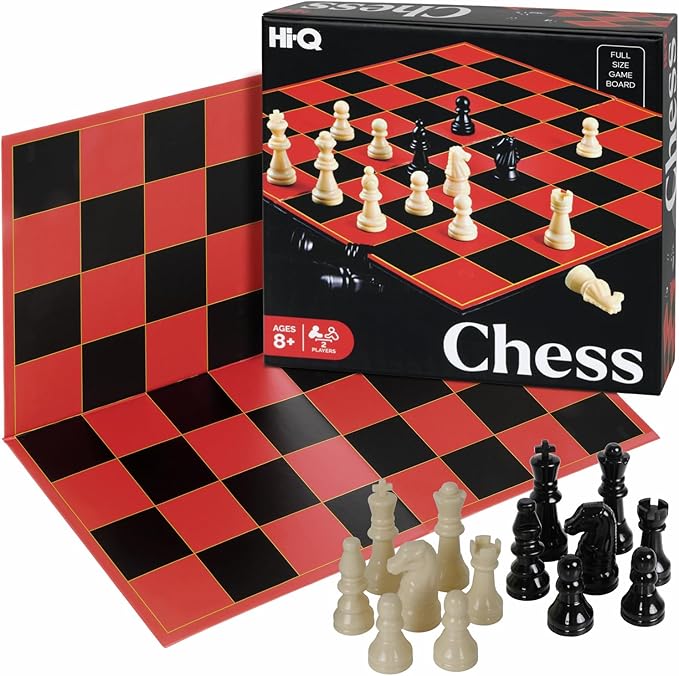
Hi-Q Classic Chess Board Game
A simple, well-built tournament-style chess set is the cheapest possible training ground for the kind of strategic thinking heavy euros demand. The Hi-Q Classic Chess Board Game is a solid wood folding board that doubles as storage, fine for daily play, and a defensible $25-ish purchase if you want to sharpen your pattern recognition before committing to an $80 box. Check current price on Amazon.
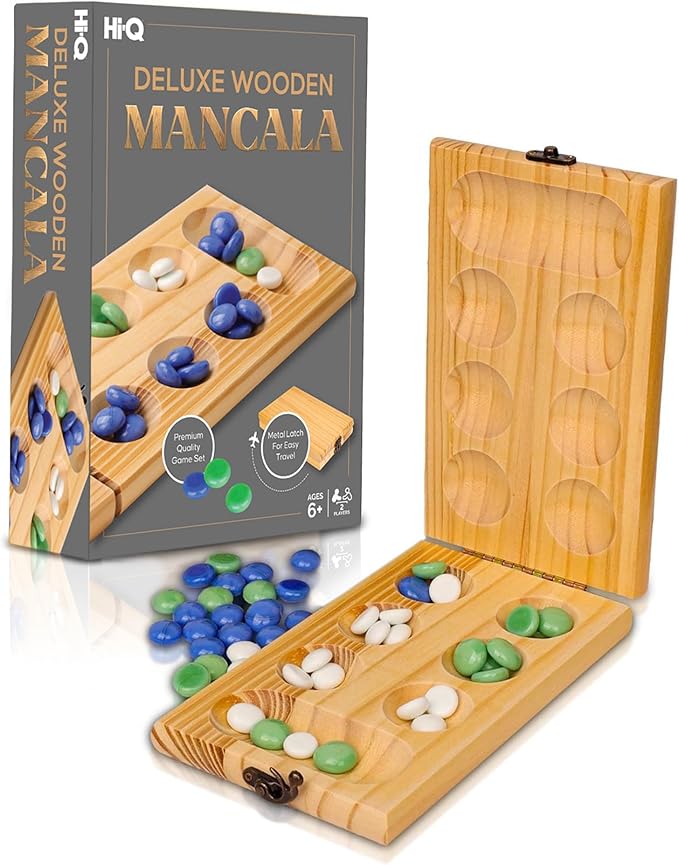
Hi-Q Solid Wood Deluxe Mancala Folding Board Game
Mancala is the quietly perfect “next move planning” trainer. It costs almost nothing, plays in 10 minutes, and forces you to count ahead three to five moves — exactly the muscle Terraforming Mars asks you to flex when chaining card plays. The Hi-Q folding wooden version stores the stones inside the board. Check current price on Amazon.
Final Recommendation
Returning to the central question of scythe vs terraforming mars for first heavy strategy game purchase: if you are buying for a household with mixed enthusiasm, buy Scythe. The components, art, and shorter playtime carry skeptics through their first session. If you are buying primarily for yourself, expect to play solo regularly, and want the deepest possible long-term puzzle, buy Terraforming Mars and budget another $40 for a player-board upgrade.
Either is a legitimately great first heavy. The mistake to avoid is buying both at once. Pick one, play it ten times, then decide whether you want the other or whether you have outgrown the on-ramp and are ready for Ark Nova, Gaia Project, or Brass.
For a broader survey of what to play after one of these, see our 2026 heavy strategy rankings.
Frequently Asked Questions
Is Scythe or Terraforming Mars easier to teach to a Catan player?
Scythe. The action-wheel structure is more intuitive than Terraforming Mars’ card economy, and a Catan player will recognize the resource-conversion loop immediately. Terraforming Mars asks new players to read and parse 8-10 unfamiliar card abilities in their opening hand, which can overwhelm someone whose previous reference is Catan.
Which game is better for two players only?
Scythe is significantly better at two. The map encourages early-game contention, combat decisions matter, and games resolve in 60-75 minutes. Terraforming Mars at two plays well but skews toward parallel solitaire — both players quietly build engines with minimal interaction.
How long does Terraforming Mars actually take with three experienced players?
Plan for two hours including setup. Adding the Prelude expansion shaves about 20 minutes by skipping the slow early generations. New players should expect three hours for their first session, mostly from card-reading time, not decision time.
Should I buy the Terraforming Mars Big Box instead of the base game?
Only if you are confident you will keep playing past five sessions. The Big Box bundles Prelude, Venus Next, Hellas & Elysium, and Colonies at meaningful savings versus piecemeal purchase, but it is a $120-150 commitment to a game you have never played. Buy base, play ten times, then upgrade if you are still hungry.
Is Scythe playable solo without buying the Automa expansion?
The base game does not include solo rules. You need either the free Automa rules from Stonemaier’s website paired with the Invaders from Afar expansion components, or the standalone Automa Factory solo deck. Plan to spend an extra $15-20 if solo is important to you.
Which one has better expansions for replayability?
Terraforming Mars wins on raw card volume — Prelude, Venus Next, Colonies, and Turmoil collectively add hundreds of new project cards. Scythe’s expansions add structural variety (modular boards, campaign mode, airships) rather than content volume. If you want “more of the same puzzle,” TM. If you want “new puzzles in the same world,” Scythe.
Are Scythe and Terraforming Mars good for kids or just adults?
Both are rated 14+ by publishers, but a strategically inclined 10-12 year old can absolutely handle Scythe with parental coaching for the first session. Terraforming Mars has more text-heavy cards that assume comfortable reading; 12+ is a more realistic floor. Neither is a family game in the Ticket to Ride sense.
If I can only afford one heavy game in 2026, which is the safer pick?
Scythe. The combination of premium components, shorter playtime, lower friction at the table, and easier teach makes it the lower-risk purchase. Terraforming Mars has a higher ceiling but a higher chance of sitting on the shelf if your group does not click with engine-builders.
Key Takeaways
- Choosing the right scythe vs terraforming mars for first heavy strategy game purchase means matching capacity and output ports to your actual devices
- Always check actual watt-hours (Wh), not just watts — runtime depends on Wh, not peak output
- Also covers: scythe or terraforming mars beginner heavy
- Also covers: first heavy euro game choice
- Also covers: scythe terraforming mars comparison
- Compare price-per-Wh across models to find the best value for your budget