If you're comparing root vs scythe for players who bounced off asymmetric faction balance, the short answer in 2026 is this: Scythe is the gentler reintroduction. Its factions look wildly different on the surface, but the player mats and faction mats combine into combos that hover within a narrow win-rate band, meaning a weaker player picking a 'tough' faction can still hold their own. Root, by contrast, leans into deliberate, dramatic asymmetry — the Marquise plays a completely different game from the Vagabond, and faction fluency matters more than tactics. If asymmetry burned you before, start with Scythe.
That's the headline. But the right pick depends on which part of asymmetric design pushed you away — the unequal power levels, the unequal rulesets, the unequal learning curves, or the unequal table presence. Let's break it down so you don't waste another $80 on a box that ends up traded away.
Why asymmetric balance bounces players in the first place
Players who bounce off asymmetric games usually fall into one of four camps, and the diagnosis matters because Root and Scythe fail differently:
- The 'I lost because of my faction, not my play' camp. You feel handicapped by the draw. This is a perception problem more than a math problem — and Scythe addresses it directly with its dual-mat system.
- The 'I don't want to learn five rulebooks' camp. Every faction has unique rules and you spent the whole first game asking what the other players were doing. Root is worse for this; Scythe is dramatically better because everyone shares 90% of the action economy.
- The 'one player runs away with it' camp. Someone at the table snowballs and the rest can't catch up. Both games can do this in untrained groups, but Root snowballs harder and faster.
- The 'I want to play the game, not the meta' camp. You don't want to memorize matchups. Scythe largely solves this. Root never will — that's the whole design.
Once you know which camp you're in, the root vs scythe for players who bounced off asymmetric faction balance question stops being abstract and starts being practical.
How Scythe handles asymmetric balance
Scythe's clever trick is that asymmetry is layered, not stacked. Every player gets a faction mat (which gives unique units, abilities, and starting position) and a player mat (which dictates the cost and reward structure of the four core actions). The factions look wildly different — the Crimean Khanate plays like a card-flinging skirmisher, Rusviet hammers production, Nordic crosses rivers — but the underlying engine is identical. Everyone trades, produces, moves, fights, deploys mechs, builds buildings, and enlists recruits using the same turn structure.
That means the cognitive load of learning an opponent's faction is roughly 10% of what it is in Root. When the Saxony player attacks you, you don't need to flip through a separate rulebook to know what happens. The combat math is the same — they just have a faction-specific power that lets them gain stars from combat losses.
The published faction-vs-mat win rates have been tracked obsessively by the community for nearly a decade, and the much-discussed Rusviet/Industrial combo (which used to win ~70% of the time) was officially banned in tournament play by Stonemaier years ago. The remaining matchups sit between 45% and 55% — tight enough that table skill outweighs your faction draw in almost every game.
How Root handles asymmetric balance
Root is the opposite philosophy. Each of the four core factions has its own scoring engine, its own action economy, its own win rate, and its own role at the table. The Marquise builds an industrial sprawl. The Eyrie locks into a self-destructive decree. The Woodland Alliance ferments sympathy and revolts. The Vagabond runs around solo making friends and enemies.
Cole Wehrle has been explicit that Root is meant to feel like four people playing four different games on the same map — and that imbalance is a feature because each faction is reactive to the others. The Marquise should dominate early; the Alliance should punish that dominance; the Eyrie should rush before the board calcifies. When players know their roles, the game self-corrects beautifully. When they don't, one player runs away by turn six.
The hard truth: if you bounced off Root, learning more factions or buying expansions (Riverfolk, Underworld, Marauder) will not fix it. It'll deepen the same problem. The Lizard Cult and Corvids are the most asymmetric faction designs in modern board gaming. Root is not trying to be balanced — it's trying to be dramatic.
Direct comparison: Root vs Scythe in 2026
| Factor | Scythe | Root |
|---|---|---|
| Asymmetry style | Surface-level (same engine, different powers) | Deep (every faction has its own engine) |
| First-game faction-draw anxiety | Low — published win rates within 10% | High — Vagabond and Cats are notably easier early |
| Rules each player must learn | Shared core + 1 faction power sheet | Shared core + 1 full faction rulebook |
| Player count sweet spot | 3–5 (solo automa available) | 3–4 (2-player is a different game) |
| Game length | 90–115 min | 60–90 min |
| Comeback potential | Strong — sudden end triggers | Weak — leader rarely caught without coalition pressure |
| Re-explanation cost per session | Low | High |
| If you bounced off asymmetry | Try again | Skip until your group is ready |
What to play instead while you rebuild your appetite for asymmetry
One pattern we see constantly: players who got burned by Root in particular need a palate cleanser before they're willing to risk another heavy asymmetric box. The fix isn't a lighter asymmetric game — it's a symmetric one that scratches the strategy itch without making your faction choice feel like fate. A few classic, low-stakes recommendations that physically reset the bad taste:
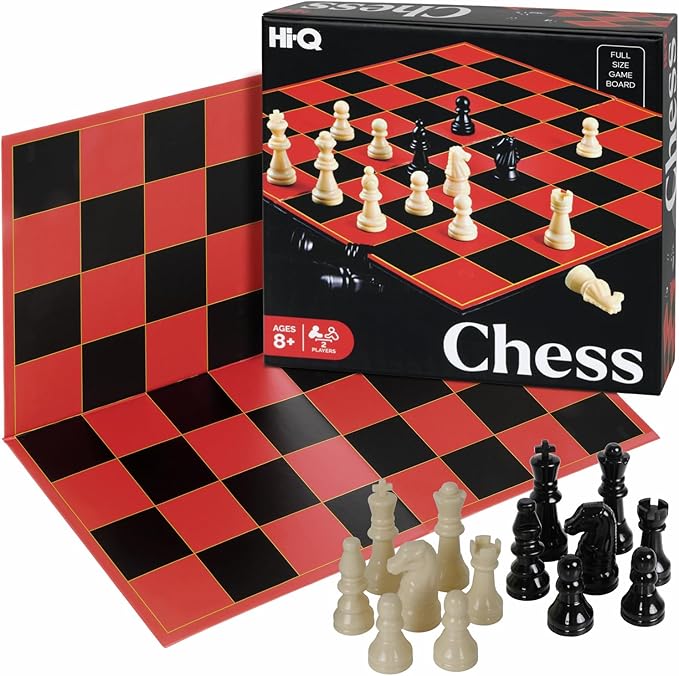
Hi-Q Classic Chess Board Game
Chess is the original cure for asymmetry-fatigue. Identical armies, identical opening positions, identical resources — every loss is unambiguously your own. Hi-Q's Classic Chess set is a solid wood entry point that lives on a coffee table rather than in a tournament case, which matters: you want this game accessible, not ceremonial. Two or three evenings of chess between heavy-game sessions tends to rebuild the 'I lost because I played worse, not because I drew worse' instinct that asymmetric games can erode. Hi-Q Classic Chess on Amazon.
Kangaroo Multiplayer Strategy Checkers Board Game
If chess is too heavy for the role we're asking it to play here — a quick, no-faction palate cleanser — checkers does the same job in 20 minutes. The Kangaroo Multiplayer set in particular is built for 3–4 players, which mirrors the count you'd be playing Root or Scythe at, so the social dynamic is preserved even if the asymmetry isn't. It's a useful bridge while your group remembers how to play with each other instead of around each other. Kangaroo Strategy Checkers on Amazon.
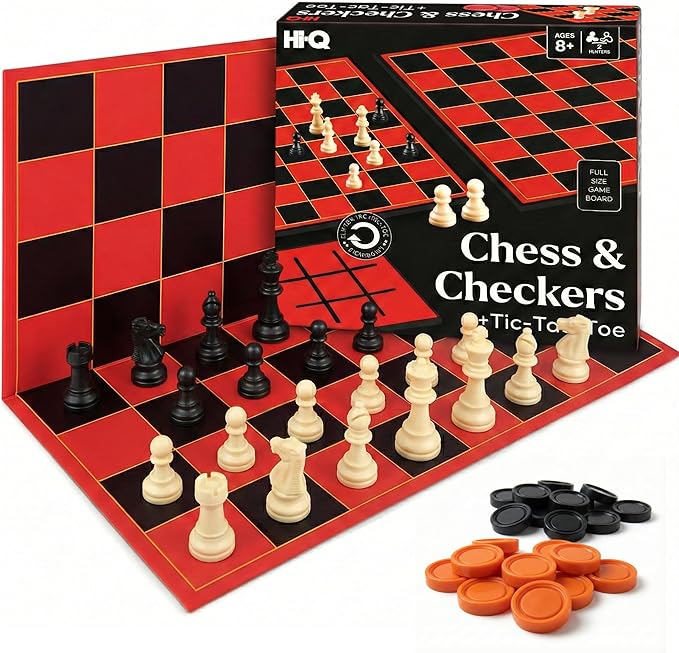
Hi-Q 3-in-1 Chess, Checkers & Tic-Tac-Toe Folding Set
For the player who wants options without committing to a single classic, the 3-in-1 folding set is a travel-friendly catch-all. We recommend it specifically because the folding form factor encourages spontaneous play — and the antidote to asymmetric-game burnout is frequency, not weight. Three short symmetric games a week will repair the relationship faster than one heavy game a month. Hi-Q 3-in-1 Folding Set on Amazon.
Hi-Q Solid Wood Deluxe Mancala Folding Board Game
Mancala deserves a mention for one specific reason: it's almost pure mechanism, no theme, no factions, no narrative drag. After a frustrating Root session where the table arguments about whether the Vagabond was 'playing the game right' wore everyone out, a couple of rounds of mancala lets the group's strategic muscles relax. The Hi-Q solid wood version is heavy enough to feel like a real game, not a kids' toy. Hi-Q Deluxe Mancala on Amazon.
So which one should you actually buy?
Decision rules, in order of strictness:
- If you bounced off asymmetric faction balance specifically because you felt your faction lost the game for you: buy Scythe. The data is on your side — the win rates are tight and the design is forgiving.
- If you bounced off asymmetry because nobody at the table knew what anyone else was doing: buy Scythe. The shared engine cuts faction-explanation overhead by an order of magnitude.
- If you bounced off asymmetry because one player ran away with the game: buy neither yet. Play a few cycles of symmetric games (chess, checkers, mancala, or a heavier euro like Terraforming Mars) until your group reads the leader and applies pressure. Then buy Scythe.
- If you bounced off Root specifically and the table loved it apart from you: keep playing Root, but commit to the Vagabond or Marquise for five games in a row. Both have the smoothest learning curves and the most generous error bars. Don't switch factions until you've felt one click.
- If you bounced off Scythe: Root will not save you. The complaint pattern is different — Scythe-bouncers usually want faster games or more interaction, and Root delivers both, but at a much higher faction-fluency cost.
For more on choosing between modern heavy games, see our breakdown of Terraforming Mars vs Scythe for engine-builders and our guide to the best asymmetric board games for 3 players in 2026. If you've decided Root is worth a second try, our Root faction tier list for new players ranks every faction by learning curve, not power level — which is what actually matters on your first re-attempt.
Frequently Asked Questions
Is Scythe actually balanced or just less unbalanced than Root?
Scythe is genuinely close to balanced once the Rusviet/Industrial combo is banned (which is the community standard and what Stonemaier officially recommends). Tracked faction-mat combos sit within a 45–55% win-rate band, which is tighter than most asymmetric games. Root's factions, by contrast, can swing 15–25% in win rate depending on player count and skill — and that's by design.
Will Root expansions fix the faction-balance problem?
No. The Riverfolk, Underworld, Marauder, and Homeland expansions add more asymmetric factions, not balancing mechanics. The Riverfolk expansion does add Hirelings and the Vagabond variant, which can soften an asymmetric session for newer groups, but the core design philosophy doesn't shift.
Is Root vs Scythe a fair comparison if Root is 60 minutes and Scythe is 110?
It's the comparison players actually make, because both are mid-to-heavy strategy games with faction asymmetry as the headline feature. The length difference does matter though — a bad Root game ends quickly; a bad Scythe game drags. For groups burned by asymmetry, the faster recovery time of Root is a real argument in its favor once you're past the learning curve.
What's the best 2-player game between Root and Scythe?
Scythe, decisively. Root's 2-player mode requires the Clockwork expansion's bot factions or extensive house-ruling, and most groups find it unsatisfying. Scythe's 2-player game retains most of the 4-player tension and the published Automa solo/2P system is widely considered the gold standard.
If I bounced off both Root and Scythe, is there an asymmetric game I'd actually enjoy?
Look at Spirit Island (cooperative asymmetry — no player feels 'behind' another), or Cosmic Encounter (asymmetric powers but games are short and chaotic enough that balance becomes funny rather than frustrating). Both sidestep the specific failure modes that bounce players off Root and Scythe.
Does player count change the answer to root vs scythe for players who bounced off asymmetric faction balance?
Yes. At 4 players, Root sings and Scythe is solid. At 5+, Scythe still works and Root falls apart (it physically caps at 4 without the Marauder expansion's adversaries). At 3, both work but the asymmetry feels more pronounced because there are fewer opponents to absorb a runaway leader. If you're a 3-player group and you bounced off asymmetry, Scythe is the right call.
Are Root and Scythe still worth buying in 2026, or are there newer alternatives?
Both are still firmly in print, supported, and considered modern classics. Newer asymmetric titles like Oath, Arcs (also Cole Wehrle), and Sidereal Confluence are excellent but more demanding. For a player rebuilding confidence with asymmetric design, the established stability of Scythe — which has nearly a decade of community optimization behind it — is exactly the safe entry point that newer games can't yet offer.
Key Takeaways
- Choosing the right root vs scythe for players who bounced off asymmetric faction balance means matching capacity and output ports to your actual devices
- Always check actual watt-hours (Wh), not just watts — runtime depends on Wh, not peak output
- Also covers: Root or Scythe faction balance
- Also covers: asymmetric games for picky strategy players
- Also covers: Root vs Scythe new player learning curve
- Compare price-per-Wh across models to find the best value for your budget