If you're weighing catan vs everdell for engineers who overthink resource conversion ratios, the short answer is this: Catan rewards you for modeling a noisy stochastic market where 4:1 is the worst-case bound and 2:1 ports are arbitrage opportunities, while Everdell rewards you for building a deterministic engine where one card's discount cascades into a 6-to-1 effective conversion by the final season. Catan is the better game if you enjoy probability tables and live negotiation. Everdell is the better game if you enjoy combo-chaining a tableau until your worker actions feel like free money. Both punish sloppy thinking, but they punish it in completely different ways, which is why so many systems-minded players own both.
This guide is written for the kind of player who has, at some point, opened a spreadsheet to settle a board game argument. We'll walk through the actual math of each game's economy, where the conversion ratios sit, where the hidden exchange rates live, and which title is the better fit for your particular flavor of overthinking in 2026.
The core question: what counts as a "resource conversion ratio" in each game?
In Catan, conversion ratios are explicit and posted on the box. The bank trades 4:1. Generic ports trade 3:1. Specialty ports trade 2:1 for a single resource type. Player-to-player trades are unbounded and negotiated, which is where the game's true economy lives. A grain-for-ore trade at 1:1 between two players late in the game can be worth more than any port, because both sides are converting toward city upgrades and development cards simultaneously. The interesting engineering problem in Catan is that your conversion rate is a function of social capital, board position, and the dice distribution you've observed so far.
Everdell hides its conversion ratios inside cards. There is no posted exchange rate. Instead, every Construction has a build cost in twigs, resin, pebbles, and berries, and every Critter has a cost that can be waived or discounted by a matching Construction already in your city. That waiver is the conversion ratio. A Husband played for free because you already have a Farm is, mechanically, a 3-resource-to-0 conversion. The Inn lets you play a card for 3 fewer resources, which is a discrete discount that compounds across a game.
So the framing matters. Catan is a continuous market with negotiated prices. Everdell is a discrete combinatorial puzzle with cliff-edge discounts. For engineers who overthink resource conversion ratios, the question is really whether you want to optimize against humans or against a deck.
Catan's economy, modeled honestly
The standard Catan board has 19 hexes and a roll distribution centered on 7. The expected production per turn for a settlement on a 6 or 8 hex is roughly 0.278 resources per dice roll, or about one resource every 3.6 rolls. A city on the same hex doubles that. The dots-per-number system on the tokens is already an analog of expected value, and any engineer who has played twice has done this math in their head.
The conversion ladder in Catan looks like this. Four like resources to one of your choice at the bank. Three like resources to one at a generic harbor. Two like resources to one at a specialty harbor. One-for-one or better with another player. A road costs 1 wood and 1 brick. A settlement costs 1 each of wood, brick, sheep, and grain. A city costs 2 grain and 3 ore. A development card costs 1 each of sheep, grain, and ore.
The non-obvious arbitrage is that the city-and-dev-card economy is heavily ore-and-grain weighted, while the early expansion economy is wood-and-brick weighted. The player who flips from "land grab" to "city grind" at the right moment is converting their early-game wood-brick surplus into mid-game ore-grain trades, often at favorable rates because everyone else still needs wood. The 2:1 wood port is a trap if you don't have the wood; it's an absolute weapon if you do.
Everdell's economy, modeled honestly
Everdell has four resources, eight worker actions per game in a standard play (2, 3, 4, then 4 again after Prepare for Season), and a 15-card city limit. Every point you score has to fit inside that 15-card tableau, which makes the real conversion ratio one of card slots, not resources.
The headline combos are the Construction-into-Critter discounts. Farm enables free Husband and Wife. Mine enables free Miner Mole. Theatre enables free Bard. Each of these saves 2-4 resources, which compounds because the resources you didn't spend can be reinvested into more discounted plays. A well-built Everdell city in 2026's optimal-play meta typically discounts 12-18 resources over the course of the game, which is roughly a third of total economic throughput.
The deeper conversion is the point density per card slot. Wanderer is 1 point and takes a slot. King is 4 base points plus 1 per Prosperity card, which can hit 9 or 10 in a tuned city. The Husband-Wife pair gives 3 bonus points if both are present. Engineers will recognize this as a knapsack problem with a side constraint on enabler cards, and that's exactly what good Everdell play feels like.
Side-by-side comparison
| Dimension | Catan | Everdell |
|---|---|---|
| Posted conversion ratios | 4:1, 3:1, 2:1 at bank/ports | None; conversions are card-by-card discounts |
| Best-case effective ratio | 1:1 via player trade | Effectively infinite when a Critter is played free |
| Source of randomness | Dice every turn | Card draw and meadow refresh |
| Negotiation | Core mechanic | None; fully solo-optimization |
| Game length | 60-90 minutes | 45-75 minutes |
| Player count sweet spot | 4 | 2-3 |
| Engineer appeal | Live market modeling | Combinatorial engine building |
| Solo mode | No (officially) | Yes, with Rugwort variants |
Which one is right for your specific overthinking style?
If you reach for Monte Carlo simulations, expected-value tables, and bid-ask spreads, Catan is your game. The randomness of the dice means there is no closed-form optimal play, only good heuristics, and the negotiation layer means your conversion ratio is whatever you can talk someone into. This is closer to actual market making than almost any other mainstream board game.
If you reach for dependency graphs, dynamic programming, and constraint solvers, Everdell is your game. Every card is a node. Every enabler relationship is an edge. The game is essentially asking you to find the highest-scoring 15-node subgraph subject to resource and worker constraints. The catan vs everdell for engineers who overthink resource conversion ratios debate often ends here: do you want a noisy human-facing game or a quiet puzzle-facing game?
For a longer treatment of why deterministic engines feel different from stochastic markets, see our companion piece on engine builders vs market games and the breakdown of probability distributions in eurogames.
Adjacent strategy games worth owning
Neither Catan nor Everdell scales down to a quick 15-minute filler, and both require a full table. The picks below are abstract or near-abstract strategy games that scratch the same overthinking itch in shorter sessions, which is why engineers who own Catan and Everdell tend to also own at least one of these.
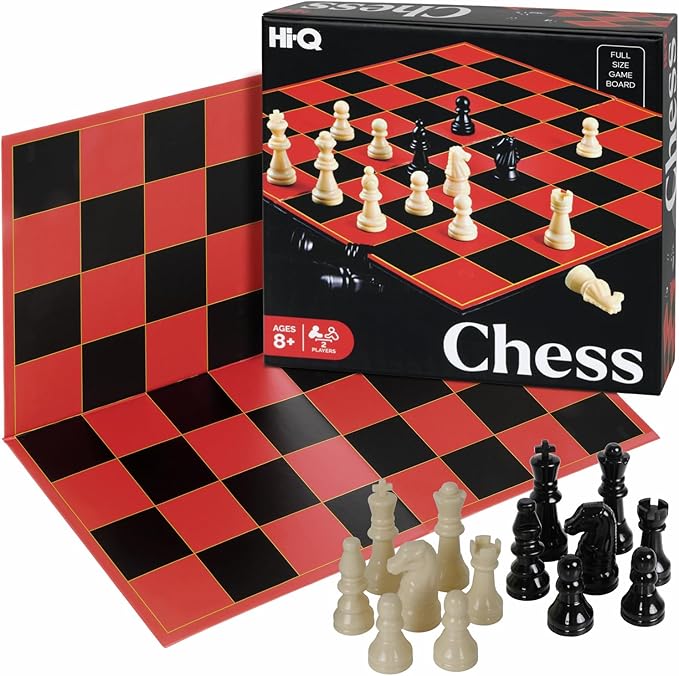
Hi-Q Classic Chess Board Game, Educational Strategy Set
Chess is the canonical zero-randomness strategy game, and it's a useful counterweight to Catan's dice and Everdell's card draw. If your overthinking is being held hostage by variance, an hour of chess resets the calibration. The Hi-Q Classic set is a solid wooden board with weighted pieces that holds up to nightly play, which matters if you're the household member who actually pulls games off the shelf. Available at HI-Q Classic Chess Board Game – Educational Strategy Set for.
Hi-Q Solid Wood Deluxe Mancala Folding Board Game
Mancala is the closest you can get to Everdell's combinatorial vibe in under 15 minutes. The whole game is a sequence of integer redistribution problems, and the optimal-move space is small enough that strong players genuinely calculate three to five moves ahead. The folding wooden board travels well for engineers who want a pocketable optimization puzzle for flights and lunch breaks. Available at Hi Q Mancala Board Game, 2 Player Classic Strategy Table Gam.
Kangaroo Multiplayer Strategy Checkers Board Game
Standard checkers is solved, but the multiplayer variant on this board introduces a third-party dynamic that's surprisingly close to Catan's negotiation layer. Two players ganging up on a leader is a classic Catan moment, and this set lets you practice that social-dynamic instinct in a much shorter game. Useful as a warm-up before a Catan night. Available at Kangaroo - Multiplayers Strategy Checker Board Game for Kids.
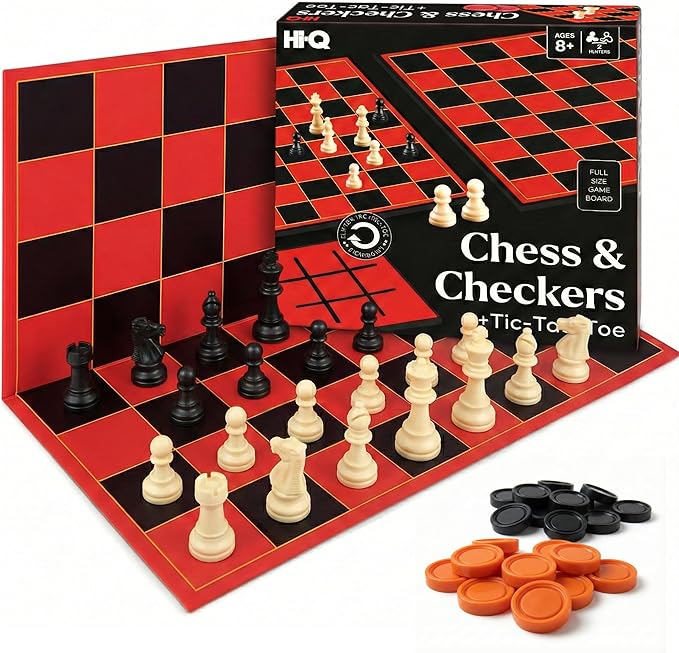
Hi-Q 3-in-1 Chess, Checkers and Tic-Tac-Toe Folding Set
If you want one box that covers three solved-or-nearly-solved games for filler rounds between heavier sessions of Catan or Everdell, this 3-in-1 folding set is the most economical pick. Engineers who like to compare optimal-strategy spaces across game-theory complexity classes will get a lot of use out of having all three on one board. Available at 3-in-1 Chess, Checkers & Tic-Tac-Toe Game Set – Double-Sided.
The verdict on catan vs everdell for engineers who overthink resource conversion ratios
Buy Catan first if you mostly play with four people who like to talk. Buy Everdell first if you mostly play with two people who like to think. Buy both if you have any interest in the broader Eurogame design space, because together they cover the two dominant economic-design philosophies of the last two decades. The catan vs everdell for engineers who overthink resource conversion ratios question only really has a wrong answer if you pick the game that doesn't match your usual table.
For a deeper dive into the broader category, see best resource management board games 2026.
Frequently Asked Questions
Is Everdell harder to learn than Catan for first-time strategy gamers?
Yes, modestly. Catan's rules fit on two sides of a reference card and the first turn is intuitive. Everdell has more iconography, more card types, and a season-and-worker structure that takes one full play to internalize. After two games, however, Everdell's decision tree feels cleaner because there is no negotiation phase.
Which game has the better solo mode for engineers who like puzzle optimization?
Everdell. The official Rugwort solo variants and the Pearlbrook expansion's solo mode are well-tuned and turn the game into a focused engine-building puzzle. Catan has no first-party solo mode, and the fan-made variants do not preserve the game's negotiation core.
How do the Catan 2:1 ports compare to Everdell's discount cards in raw economic value?
A Catan 2:1 port saves one resource per conversion and is useful roughly four to eight times per game, so it provides 4-8 resources of total value. A well-placed Everdell discount card like Inn or Crane saves 3 resources per use and can fire 2-4 times, providing 6-12 resources of value. Everdell discounts have higher ceilings; Catan ports have higher floors because they cannot be denied by card draw.
Does Everdell's Pearlbrook expansion change the conversion math significantly?
Yes. Pearls become a fifth resource and Adornments offer end-game point conversions that can swing 8-15 points. The expansion roughly doubles the depth of the combinatorial optimization problem, which most engineering-minded players consider an improvement.
Can you reasonably model Catan trade negotiations with game theory?
Partially. The two-player surplus is bounded by each player's best alternative, which is the relevant port or bank rate, so any trade better than 3:1 for both sides is rational. The non-modelable part is the social dynamic of who wants to deny whom victory, which dominates trade behavior in the final 20 percent of the game.
Which game ages better with repeated play for an engineering-minded household?
Everdell, because the deck variability and expansion content keep the optimization space fresh. Catan's strategic space is mostly solved at the heuristic level after 30-50 plays, and the dice noise becomes the main source of novelty rather than the strategy itself.
Is there an alternative game that splits the difference between Catan's negotiation and Everdell's engine building?
Yes, look at Wingspan for engine building with light negotiation, or Brass Birmingham for a heavier market-and-network hybrid. Both are recommended in our eurogame buyer's guide 2026 for players who want the middle ground.
Key Takeaways
- Choosing the right catan vs everdell for engineers who overthink resource conversion ratios means matching capacity and output ports to your actual devices
- Always check actual watt-hours (Wh), not just watts — runtime depends on Wh, not peak output
- Also covers: catan vs everdell economy comparison
- Also covers: resource management games for engineers
- Also covers: catan vs everdell trade efficiency
- Compare price-per-Wh across models to find the best value for your budget